By Caroline
The Only Italian Lasagna Recipe You'll Ever Need
Updated at: Mon, 31 Mar 2025 01:53:49 GMT
Nutrition balance score
Unbalanced
Glycemic Index
67
Moderate
Nutrition per recipe
Calories5945.7 kcal (297%)
Total Fat333.6 g (477%)
Carbs448.2 g (172%)
Sugars69.2 g (77%)
Protein255.9 g (512%)
Sodium2326.4 mg (116%)
Fiber20 g (71%)
% Daily Values based on a 2,000 calorie diet
Ingredients
0 servings


Instructions
Pasta sheets
Step 1
Place of the flour on your cutting board (reserve 50 grams or so, a little more than 1/3 a cup) – wood is the best material to knead on, but plastic boards or even just your countertop are okay, too – and make a hollow in the center of our little pile so it looks like a flour volcano.
Step 2
Break the eggs into the “crater” of the volcano, and stir them with a fork so that the yolks and whites mix before you begin to incorporate them into your flour.
Step 3
Start to incorporate the eggs and flour by slowly bringing more flour in from the inside edges of the “crater”. Continue mixing the flour with the eggs until the mixture comes together.
Step 4
Knead everything together for 10 minutes pushing it down with the heel of your hand, turning, stretching, folding, then smashing it down again. Kneading is necessary to work the gluten in the dough and make it more elastic.
Step 5
Chef’s Tip If you find the dough too hard, add a spoonful of warm water. If it’s a little sticky, add some of the flour you left aside at the beginning. Do not add any more flour than what you have reserved specifically for this purpose.
Step 6
Wrap the prepared dough in plastic wrap, and put it aside – in a dry place – to let it rest for at least 30 minutes, or up to 24 hours in the refrigerator. This step is particularly important if you are rolling your pasta by hand because it is necessary to relax the gluten in the dough. If you don’t let the gluten relax and try to roll it with a rolling pin you had better hope you have forearms like an Italian nonna (i.e., corded with thick muscles) because you’re going to have a hard time. However, if you have a pasta maker you don’t necessarily need to relax the dough, just be aware that the final product will be a bit stiffer.
Step 7
Sprinkle a little flour on your cutting board. Unwrap your dough, and push it down a little with the palm of the hand. At this point, you have two options the rolling pin OR a pasta machine!
Step 8
If you opt for the rolling pin, sprinkle just a little bit of flour on the dough and start rolling the pin back and forth using light pressure until it reaches a thickness of 0.5mm.
Step 9
Chef’s Tip After about a minute a minute of rolling , roll the far edge of the dough around the pin, hold the opposite edge with your hand and roll the pin towards yourself. Then roll it back in order to “unfold” it. Once unfolded, rotate the dough 90° to the right and repeat.
Step 10
If you have a pasta-making machine, cut the dough into quarters or (eighths, depending on the size of the machine) then flatten a quarter of the dough and sprinkle it with flour before feeding it into the machine. Begin with the highest thickness option – i.e, the widest setting. When you have rolled out one strip, fold it in half and pass it through again. Continue by reducing the width of the rolling slot, until you reach a thickness of approximately 0.5mm. Also remember that every time you make the width of the rolling slot shorter, you have to pass the dough through it twice, folding it in half for the second pass.
Step 11
Cut the big sheet of pasta or the strips of pasta into rectangles of about 20 cm x 14 cm (8 inches x 5 inches)and cook them in boiling water for 30 seconds. Dry them and set aside on clean kitchen towels.
Ragú
Step 12
Heat a healthy glug of olive oil in a large pan or dutch oven while you peel the carrot and the onion. Wash and dry the celery. Cut the three of them into tiny pieces. and cook them over a low heat until they are soft (roughly 5 minutes).
Step 13
Turn the heat to medium-high and add the ground beef and ground pork. When the meat has browned and the liquid it releases has evaporated, add the white wine and stir. When the wine has evaporated, add the passata, salt, and pepper. Stir again to mix the and let them cook on a low heat for at least an hour.
Besciamella
Step 14
Put the ragù aside and get ready to make your bechamel, or as we say in Italy, “Besciamella” sauce.
Step 15
Warm the milk in a saucepan, but don’t let it boil.
Step 16
In a separate saucepan, cube the butter and melt it over low heat. As soon as it has liquefied take it off the heat and gradually whisk in the flour, making sure that no lumps form.
Step 17
Place the pan with the butter and flour mixture back on a low heat and add your warm milk, salt, nutmeg and ground pepper. Stir rapidly with the whisk until it thickens and becomes smooth.
Assembly
Step 18
Pour a fine layer of besciamella on the bottom of your casserole dish.
Step 19
Cover it with a layer of ragu.
Step 20
Place your pasta rectangles side-by-side on top of the ragu until you have covered it completely. Don’t allow them to overlap too much – you don’t want any double layers of pasta.
Step 21
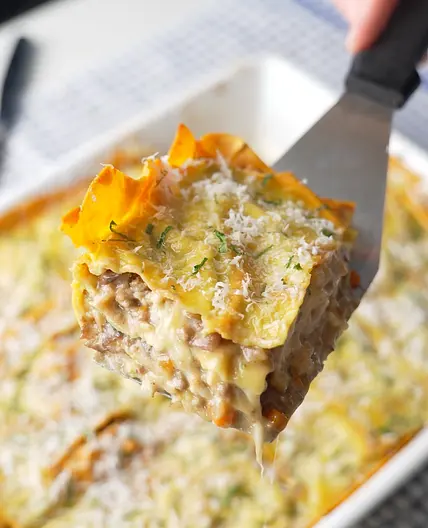
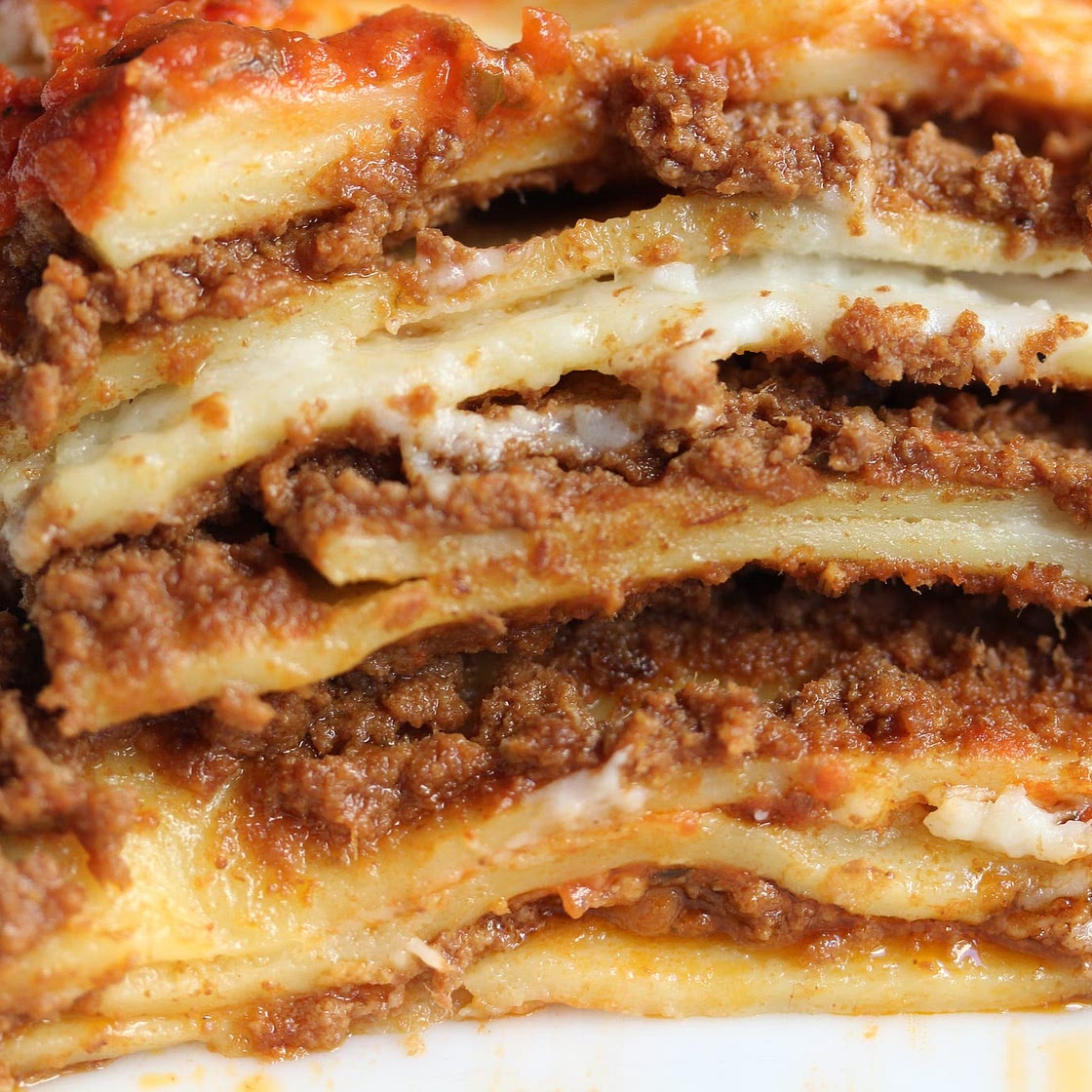
Repeat the process in the same order as above until you reach 5 or 6 layers of pasta. On the very last layer of pasta place a slightly thicker layer of bechamel and ragù as it is the layer most exposed to the hot air of the oven and tends to dry up a little. Sprinkle some parmesan cheese on top, or between the layers if you like, but this is not a requirement.
Step 22
Place the casserole in a pre-heated oven at 200° Celcius (390 Fahrenheit) for about 25 minutes. You will know the lasagna is ready when you can see a golden crust around the outside edges on the top layer.
Notes
1 liked
0 disliked
There are no notes yet. Be the first to share your experience!