
By Ciara M
Junket’s Basic Hard Cheese
The fresher the milk, the more predictable the cheese. You can substitute the buttermilk for half a cup of plain yogurt with live and active cultures. You can sterilize your cooking pot by boiling half an inch of water inside with the lid on.
Updated at: Fri, 22 May 2026 18:19:36 GMT
Nutrition balance score
Uh-oh! We're unable to calculate nutrition for this recipe because some ingredients aren't recognized.


Instructions
Step 1
The evening before you plan to make the cheese, warm one gallon of fresh milk to 68 degrees F in a sterilized pot. Thoroughly blend in 1/4 cup of buttermilk to inoculate. Cover inoculated milk with sterilized lid. Let it sit out at room temperature overnight.
Step 2
The next morning, gently warm the milk to 86 degrees F. Meanwhile, dissolve 1/2 tablet of rennet in 1/4 cup cold water.
Step 3
Stir the dissolved rennet into the warmed milk and mix thoroughly. Cover, let sit undisturbed for an hour or more in a warm place in the room. Do not disturb the milk until it has coagulated.
Step 4
Test for a “clean break” (completed action of rennet): probe a clean finger into the milk and lift. If it has gelled enough to break cleanly as the finger is lifted, go to the next step. If the milk is liquid or semi-gelatinous and softly flows across your finger, let it sit until a clean break is obtained. It may take as long as 1-2 hours more. Be patient, do NOT disturb the milk.
Step 5
Once a clean break is achieved, cut the curd with a long knife: begin at the edge of the pot and cut straight to the bottom. Cut repeatedly parallel to first cut, but increasing angle of the knife until reaching 45 degrees at the other side of the pot. Rotate the pot a quarter of a turn, cut as before. Repeat the rotating and cutting 2 more times, yielding 1/2 inch cubes of curd.
Step 6
Place the pot over a low fire, stir curd with cleaned bare hand by reaching down to bottom, gently lifting and stirring. Cut larger curds as they appear. Do not mash or squeeze. Continue stirring for 15 minutes to prevent the curds from clumping together or overheating at the bottom. Warm the curds to 92 degrees F for softer curd cheese, or as high as 102 degrees F for very firm cheese.
Step 7
Stir and maintain 92 degrees F until curd has contracted to consistency of firm scrambled eggs. Remove from stove and let sit for 10 minutes. The curds should sink in whey. Pour off the whey in a strainer and save for ricotta if you wish. Place the curds in a large bowl.
Step 8
Sprinkle two teaspoons of salt over curds, working with hands to mix in. Pour off any additional whey.
Step 9
Line a smooth sided 4” x 5” tin can from which both ends have been removed with a sterile large white handkerchief. Place the still-warm curds into the cloth, press into the can. Fold the corners over the top of the curds and cover with the cut-out end of the can. Place a heavy weight on top to press down the curds. Let sit at room temperature for 12 hours or so.
Step 10
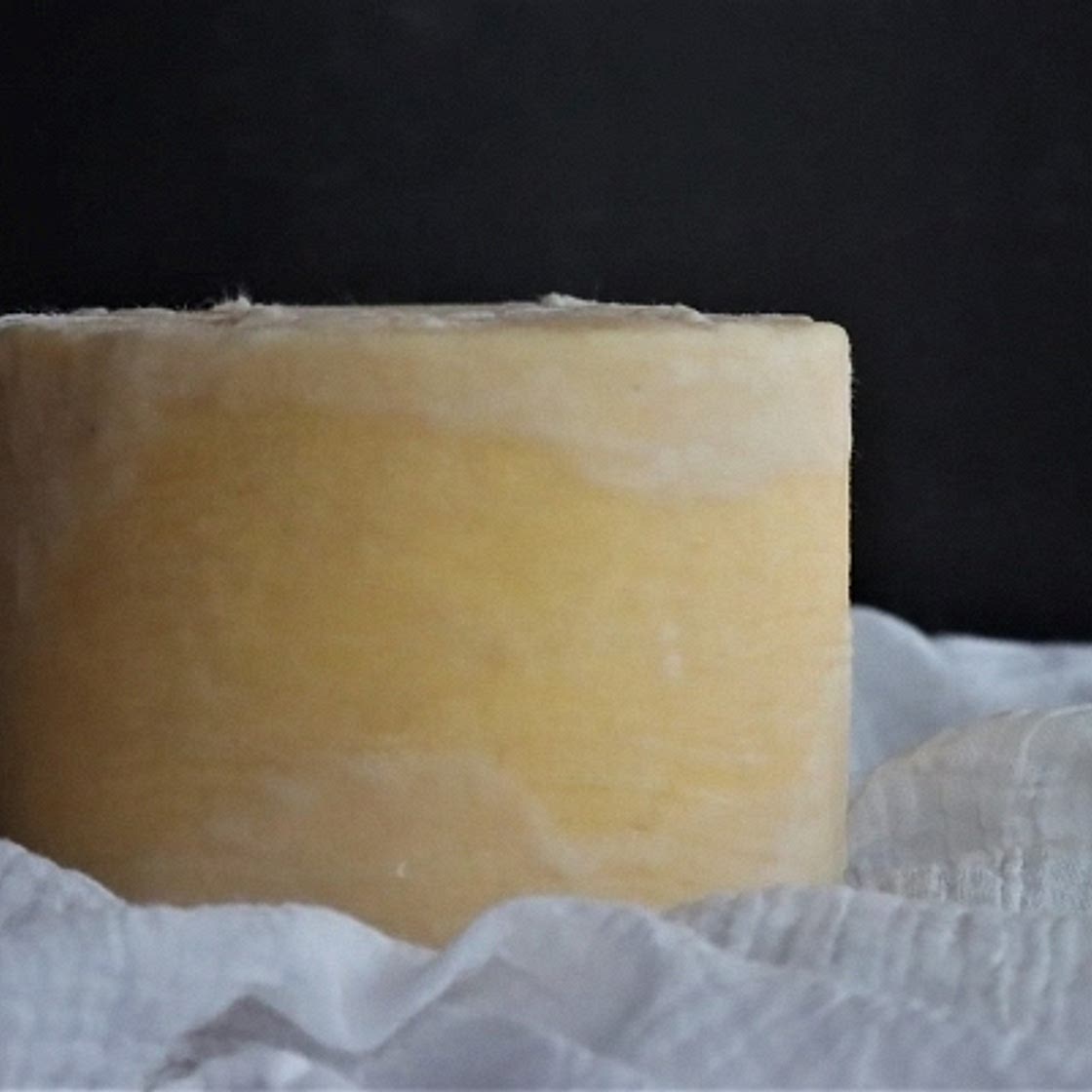
The next morning, remove and unwrap the cheese from the press. Rub the outside with salt, re-wrap with a fresh handkerchief, and place on a rack in the refrigerator. Replace “bandage” when it becomes wet, daily at first. When a dry yellowish rind forms (about one to two weeks in the refrigerator), dip in melted wax, store in refrigerator for about a month (if you can wait that long). The longer you wait, the sharper the cheese.
Notes
1 liked
0 disliked