Sarah’s Sourdough Recipe
Leave a note

Nutrition balance score
Good
Glycemic Index
73
High
Nutrition per recipe
Calories2075.5 kcal (104%)
Total Fat9.6 g (14%)
Carbs412.9 g (159%)
Sugars2.2 g (2%)
Protein69.7 g (139%)
Sodium3886.3 mg (194%)
Fiber21.1 g (75%)
% Daily Values based on a 2,000 calorie diet
Ingredients
0 servings
Feeding Sourdough


Bread

Instructions
Feeding the Starter:
Step 1
12 hours before you plan to mix the dough, add the ingredients to make ¼ cup (50 g) of active sourdough starter to a clean jar. Stir until combined, loosely cover the jar and let the starter rise at room temperature.
 Mason Jar
 Spoon
Spoon water25g
 sourdough starter10g
 all-purpose flour25g
Step 2
(The ingredients will create a total of 60 g active starter but some of it will stick to the sides of the jar during the transfer, so we are making a little more than needed.) The sourdough starter is ready to use when it has doubled in size and there are plenty of bubbles on the surface and sides of the jar.
Mixing:
Step 3
Combine 50 g of the active starter and 350 g water into a large mixing bowl. Stir.
 Bowl
Bowl SpatulaSourdough starter50gwater350g
Step 4
Add 500 g bread flour and 10 g sea salt to the bowl. Combine until dough forms.
bread flour500g salt10g
Step 5
Cover bowl and let rest for one hour at room temperature.
 Plastic wrap
 Kitchen Towel
Stretch and Fold:
Step 6
Wet your hand with a little water to prevent sticking.
Step 7
Pick up the dough on one side and stretch it up and over itself. Turn the bowl a quarter turn and repeat this step until you have turned the bowl a full circle. The dough should form into a tight ball.
Step 8
Cover the bowl and let the dough rest for 30 minutes.
Plastic wrapKitchen TowelStep 9
Repeat the stretch and fold process one more time to help build volume in the final loaf.
Bulk Fermentation:
Step 10
Cover the bowl and let the dough rise for 7-10 hours on your kitchen counter. The dough will have risen by about 50-75%, not doubled, when it is ready to shape.
(If the dough has doubled in size and/or is hard to shape, it may be over-proofed. Reduce the rising time on your next bake.)
Plastic wrapKitchen TowelShape and Rise:
Step 11
Turn the dough out onto a lightly floured surface.
Step 12
Shape the dough into a ball by pulling 4 sides of the dough into the middle of itself.
Step 13
Turn the dough over so that it is seam-side down. Use your hands to gently cup the dough, pulling and twisting towards yourself until it forms a tight skin on the outside.
Step 14
Center the dough onto a piece of parchment paper, seam-side down. Use the parchment paper like a sling to lift the dough up and transfer it into a medium-sized bowl.
 Parchment paperBowl
Step 15
Cover the bowl with a tea towel and let the dough rest at room temperature for 1-2 hours.
(Use your thumb to make an indentation in the dough about a ½ inch deep. If the indentation quickly springs back all the way, or almost all the way, it's under-proofed and still needs more time to rise.)
Kitchen TowelPreheating:
Step 16
30 minutes before you're ready to bake, preheat the oven, with the dutch oven inside, to 450°F (232°C).
Using long silicone gloves, carefully remove the hot dutch oven and take the lid off.
 OvenPreheat
 Dutch Oven
Scoring:
Step 17
Score the top of the dough with a razor or a sharp knife.
Step 18
Once again, use the parchment paper as a sling to lift the dough up and transfer it into the dutch oven.
Baking:
Step 19
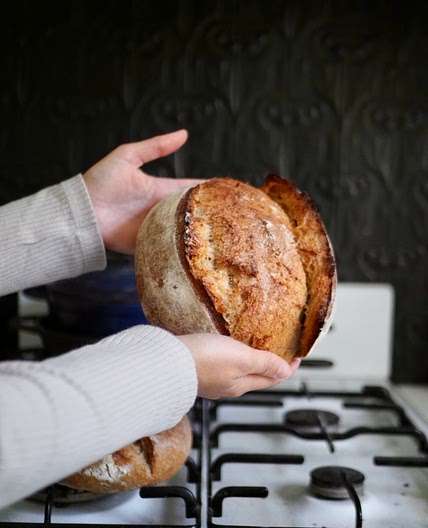
Place the lid on the dutch oven, return it to the oven and bake for 20 minutes. Remove the lid and bake an additional 25-30 minutes or until crust is golden brown.
(The internal temperature of the bread should be around 205-210°F (96-99°C) using a digital food thermometer.)
OvenHeatOvenHeatCool:
Step 20
Transfer the baked bread to a cooling rack for 1-2 hours before slicing. The bread will continue to cook inside during this time. If you slice into it too soon, it will result in a gummy loaf.
 Baking Rack
View on Beginner’s Sourdough Bread Recipe
↑Support creators by visiting their site 😊
Notes
0 liked
0 disliked
There are no notes yet. Be the first to share your experience!